
Sanity rule: change one variable per shot, take quick notes, stop after 2–3 tests.
Step 1: Set a baseline (don’t freestyle)
Most “dial-in pain” comes from starting with random numbers. Pick one baseline that works for many coffees, then steer from taste.
Baseline recipe (solid for many medium roasts)
- Dose: use your basket’s comfortable range (often ~18g for a double basket).
- Ratio: 1:2 (example: 18g in → 36g out).
- Time: aim for “reasonable flow” and use taste to guide you (often ~25–35 seconds is practical).
- Temperature: default setting is fine to start.
Measure dose
Weigh beans or grounds. “Close enough” is where inconsistency lives.
Measure yield
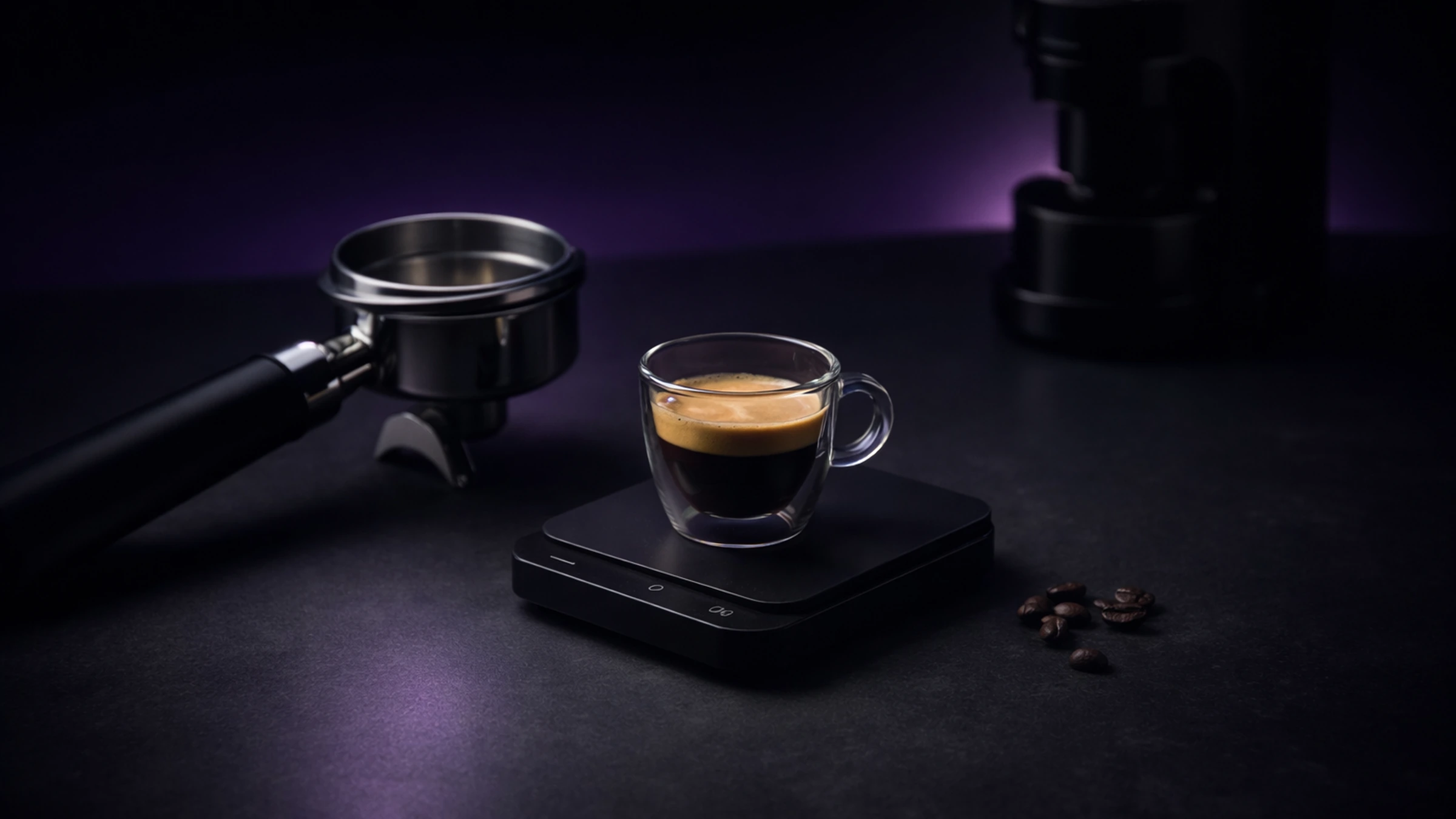
Put the cup on a scale. Stop at target grams out.
Taste first
Time is feedback. Taste tells you direction.
Step 2: Lock your workflow (before tweaks)
If puck prep changes every shot, dialing-in becomes random number generator energy. Keep your steps boring.
Prep rules
- Same basket, same dose, same tamp.
- Level distribution (avoid “mountain” or “crater”).
- Tamp level; force is less important than repeatability.
Machine rules
- Warm up consistently (or run a short flush).
- Keep portafilter warmed if your machine benefits.
- Don’t change temperature while dialing in (yet).
Step 3: Adjust in the right order
Make small moves. Espresso reacts fast, and over-correcting is the main reason people get stuck.
The adjustment order (most reliable)
- Grind size (primary control for flow and extraction).
- Yield (grams out) to fine-tune taste while staying sane.
- Dose only if you’re outside the basket’s sweet spot (or consistently choking/fast).
- Temperature last (useful for very light roasts or persistent sourness).
For most home setups: change grind in tiny steps, then re-test 1–2 shots before touching anything else.
Shot too fast?
Grind finer. Keep dose + ratio the same.
Shot too slow?
Grind coarser. Keep dose + ratio the same.
Taste “almost there”?
Keep grind, tweak yield a little.
Fix your shot: taste-first troubleshooting
Ignore espresso folklore. Use taste + flow symptoms. Make one change and re-test.
| Symptom | What it usually means | Do this first | Then (if needed) |
|---|---|---|---|
| Sour / sharp / thin | Under-extracted (or too short contact time) | Grind finer | Increase yield slightly (e.g., 36g → 38–40g) or raise temp a touch |
| Bitter / dry / ashy | Over-extracted (or too long contact time) | Grind coarser | Reduce yield slightly (e.g., 36g → 32–34g) or lower temp a touch |
| Very fast + watery | Grind too coarse, dose too low, or channeling | Grind finer | Improve distribution + level tamp; confirm dose is in basket range |
| Chokes / barely drips | Grind too fine, dose too high, or puck too dense | Grind coarser | Lower dose slightly; check basket isn’t overfilled; reduce puck prep “aggression” |
| Sprays / channeling (messy) | Uneven density and weak puck integrity | Better distribution (WDT) + level tamp | Confirm grinder consistency; consider slightly finer grind if flow is too fast |
| Good today, bad tomorrow | Routine drift, beans aging, grinder drift | Weigh dose + yield every time | Make small grind tweaks as beans age (often slightly finer over time) |
A simple 3-shot dial-in loop
Most people should be “close enough” in 2–3 shots. Past that, you’re usually fighting routine drift, not recipe.
Shot 1: baseline
- 18g in → 36g out
- Stop by yield
- Taste and choose direction
Shot 2: grind move
- Sour/fast: finer
- Bitter/slow: coarser
- Keep everything else the same
Shot 3: yield polish
- Keep grind
- Adjust yield by 2–4g
- Lock it in and stop
Then: repeatable routine
- Write down dose + yield
- Small grind tweaks as beans age
- Don’t chase perfection daily
Printable dial-in checklist
Save this section, or screenshot it. If you do these consistently, espresso becomes easy.
Before you pull a shot
- Machine warm, quick flush if needed
- Same basket, same dose target
- Scale ready (dose + yield)
- Distribution even, tamp level
During the shot
- Start timer (optional) but stop by yield
- Note: flow too fast / too slow / “okay”
After tasting
- Sour: grind finer (or yield a bit longer)
- Bitter: grind coarser (or yield a bit shorter)
- Messy spray: fix distribution and tamp
Need gear that makes dial-in easier?
A consistent grinder does more for dial-in than most machine upgrades.